
Direct Ship Commodity Transactions: Why Agribusinesses Need Connected Contracts, Tickets, Freight, and Accounting
| Published: Oct 26, 2026 | Accounting , Agronomy , Grain | read
 read
Direct ship transactions are common in grain, feed, fertilizer, and commodity trading operations. While the commodity may move directly from the seller to the buyer, the accounting, contracts, freight, invoicing, and settlement processes still need to remain connected. Many agribusinesses struggle to manage direct ship orders because critical information often arrives at different times and exists across multiple systems.
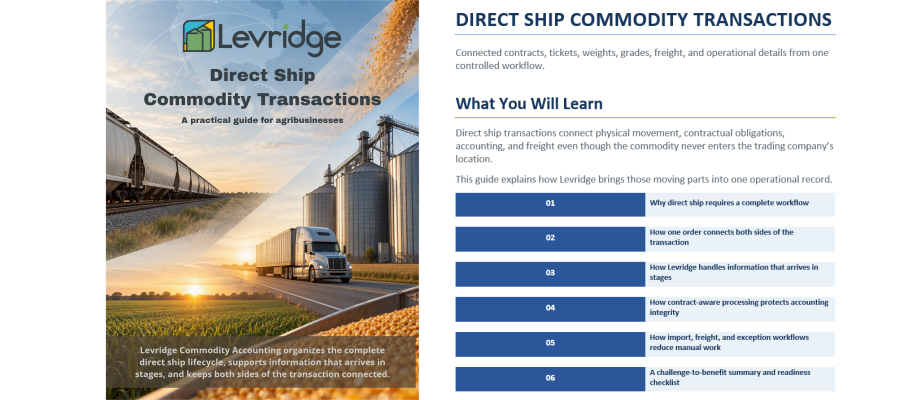
Download the Direct Ship Commodity Transactions eBook.
What Is a Direct Ship Transaction?
A direct ship transaction occurs when a commodity is delivered directly from the supplier to the customer without physically passing through the trading company’s location. Despite bypassing company inventory, the transaction still creates purchasing, sales, contract, ticketing, freight, quality, settlement, and invoicing requirements.
Examples of direct ship activity include:
- Grain shipments delivered directly to processors
- Railcar movements managed by commodity traders
- Bulk commodity purchases allocated among multiple buyers
- Grower-direct shipments where destination weights govern settlement
Common Direct Ship Challenges
Many commodity businesses rely on disconnected spreadsheets, manual data entry, and separate operational and accounting processes. This can lead to:
- Duplicate entry between purchase and sales records
- Mismatched weights, grades, and transportation details
- Contract application errors
- Delayed settlement and invoicing
- Freight records that become disconnected from the shipment
When origin weights, destination weights, grades, and freight details arrive at different times, maintaining accuracy becomes even more difficult.
Why Connected Direct Ship Workflows Matter
A modern commodity accounting system should connect every part of the transaction from a single operational record. Levridge Direct Ship Orders link both sides of the transaction, including:
- Purchase contracts
- Sales contracts
- Inbound and outbound tickets
- Weights and grades
- Freight details
- Transportation information
- Invoicing and settlement activities
This approach helps agribusinesses maintain financial integrity while reducing manual work and data re-entry.
Managing Contract Rules Without Sacrificing Accuracy
One of the biggest challenges in direct ship accounting is that purchase and sales contracts may use different governing values. For example, a purchase contract may settle on origin weight while a sales contract uses destination weight. Levridge evaluates each side of the transaction independently to ensure settlement and invoicing follow contract terms.
| Scenario | System Response | Business Value |
|---|---|---|
| New value does not govern the contract | Record the certificate or grade without automatically changing the contract application. | Preserves useful shipment history without triggering an unnecessary accounting change. |
| New value governs the contract | Unapply and reapply the eligible contract using the applicable updated values. | Aligns settlement or invoicing with the contract terms. |
| Ticket or contract state blocks the change | Reject the update and identify the reason. | Protects posted, invoiced, or otherwise restricted records. |
Levridge does more than copy data. The workflow checks the certificate type, governing weights or grades, contract application, ticket state, downstream documents, and eligible freight records before completing an update.
This contract-aware processing helps organizations:
- Protect accounting integrity
- Reduce settlement errors
- Preserve operational history
- Prevent unauthorized updates to posted records
Reducing Manual Data Entry for High-Volume Operations
Many agribusinesses receive direct ship information through Excel files containing shipment weights, grades, transportation identifiers, and certificate data. Levridge supports importing this information while applying validation and contract rules to maintain accuracy.
The system can process multiple orders from a single file while isolating row-level errors, helping organizations manage high-volume direct ship activity more efficiently.
Is Your Direct Ship Process Ready to Scale?
As transaction volumes grow, disconnected processes become increasingly difficult to manage. Agribusinesses should evaluate whether their current systems can:
- Connect buyers, sellers, contracts, and tickets from one record
- Manage origin and destination weights separately
- Synchronize inbound and outbound ticket updates
- Apply contract-specific settlement rules
- Import and validate high-volume shipment data
- Keep freight aligned with the transaction lifecycle
Download the Complete Guide
The ebook, Direct Ship Commodity Transactions, explores direct ship orders, contract-aware processing, freight management, ticket synchronization, import automation, and operational controls designed to help commodity traders improve accuracy and efficiency.
Additional Resources
- YouTube Direct Ship Playlist: https://www.youtube.com/playlist?list=PLdfVYQSAJ12s
- Direct Ship Blogs: https://www.levridge.com/whats-new/?s=direct+ship
- Commodity Accounting