
Go-Live is Only the Beginning
| Published: Aug 13, 2026 | Accounting , Ag sales , Agronomy , Equity and Patronage , Grain , News , Tips | read
 read
readThe People: Why Change Management Determines Software Success
Software success depends on people, adoption, and leadership. When organizations implement a new ERP or business software solution, most of the attention is focused on the technology itself. Teams spend months evaluating options, designing workflows, migrating data, testing processes, and preparing for go-live.
Then launch day arrives.
The system is running, users have access, and leadership is eager to begin realizing the benefits that justified the investment. But that’s when many organizations discover that implementing software and successfully adopting it are two very different things.
Employees who have spent years working a certain way don’t automatically embrace new processes simply because a new system is available. Even when the software is objectively better, change can feel uncomfortable, disruptive, and risky.
The organizations that achieve the greatest success understand a simple truth: software doesn’t drive transformation—people do.
Why Employees Resist Change
Resistance to change is often misunderstood. Leaders may assume employees are unwilling to learn something new, but that’s rarely the case. More often, employees resist change because they’ve invested years mastering existing processes.
They know where to find information. They know how to complete tasks efficiently. They know how to solve problems when issues arise.
A new system can temporarily take away that confidence. Instead of being experts, employees may suddenly feel like beginners again. Tasks that once took minutes may now require additional effort while they learn unfamiliar screens, workflows, and terminology. The goal is to help employees move through it.
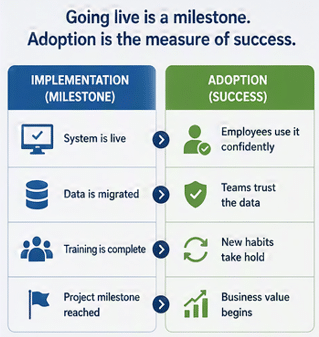
Why Go-Live Is Just the Beginning
Many organizations view go-live as the finish line of their implementation journey. In reality, it’s the starting line. Go-live marks the moment when technical implementation ends and organizational adoption begins.
The weeks and months that follow are often the most important part of the project. This is when employees develop new habits, build confidence, and begin integrating the software into their daily responsibilities.
- Organizations that expect immediate perfection often become frustrated.
- Organizations that expect a learning curve are far more successful.
They understand that adoption takes time. They plan for coaching, reinforcement, and ongoing support. Most importantly, they recognize that the return on investment will be realized over months and years—not days and weeks.
Four Ways Leaders Can Drive Adoption
Technology teams can provide training and support, but successful adoption ultimately requires leadership. The most successful organizations focus on four key actions after go-live.
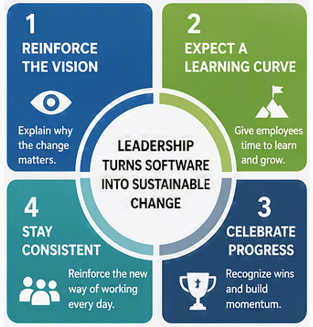
- Reinforce the Vision
Employees need to understand why the organization invested in the new system. Was the goal to improve visibility? Increase efficiency? Support growth? Reduce manual work? When people understand the purpose behind the change, they’re more likely to embrace it. Leaders should consistently communicate not just what is changing, but why it matters. - Expect a Learning Curve
One of the biggest mistakes organizations make is expecting employees to reach full productivity immediately after go-live. Learning takes time. Leaders should acknowledge that the transition period may include challenges, questions, and occasional frustration. Setting realistic expectations helps employees feel supported rather than discouraged. The focus should be on progress, not perfection. - Celebrate Progress
Employees need to know their efforts are making a difference. Recognizing teams that embrace the new system helps create positive momentum and reinforces desired behaviors. Sometimes the small wins matter most. A department that completes a process entirely within the new system or a team that successfully adopts a new workflow should be celebrated. Recognition helps build confidence and encourages others to follow. - Stay Consistent
Successful adoption requires consistency. When leaders continue to support old habits, employees receive mixed signals about what is expected. The message should be clear: the organization has made an investment in a new way of operating, and everyone is committed to making it successful. Consistency helps new habits take root and become part of the organization’s culture.
Building Long-Term Confidence
Perhaps the most important element of change management is patience. Employees don’t become experts overnight. Confidence develops through experience. Organizations that provide ongoing training, answer questions, listen to concerns, and support employees through the transition create an environment where adoption can thrive.
Over time, uncertainty gives way to confidence. New processes become second nature. Teams begin to recognize the advantages of the new system and discover opportunities they couldn’t easily achieve before.
That’s when transformation truly begins.
Success Starts with People
The most successful software implementations aren’t defined by the technology that was installed. They’re defined by the people who embraced new ways of working. Organizations that focus on communication, leadership, training, and adoption are far more likely to achieve the business outcomes they envisioned when they began their implementation journey.
Go-live is an important milestone, but it isn’t the finish line. The real measure of success is what happens next.
When leaders help employees navigate change, support them through the learning process, and remain committed to adoption, software becomes much more than a technology investment. It becomes a catalyst for lasting organizational improvement.