
Modernizing Cooperative Member Equity
| Published: Jul 13, 2026 | Equity and Patronage , Grain | read
 read
readLevridge Equity & Patronage is designed to help cooperatives manage the entire lifecycle of member equity, from transaction imports and patronage allocations to revolvements and final payments, while supporting the unique business rules of each organization.
Start with Member Transactions
The foundation of any allocation process is transaction data. Cooperatives import and categorize transactions based on their business needs, creating the foundation for accurate allocations and patronage calculations. Categories function much like share classes, allowing organizations to group activity such as:
- Grain
- Feed
- Fertilizer
- Fuel
- Other cooperative-specific business lines
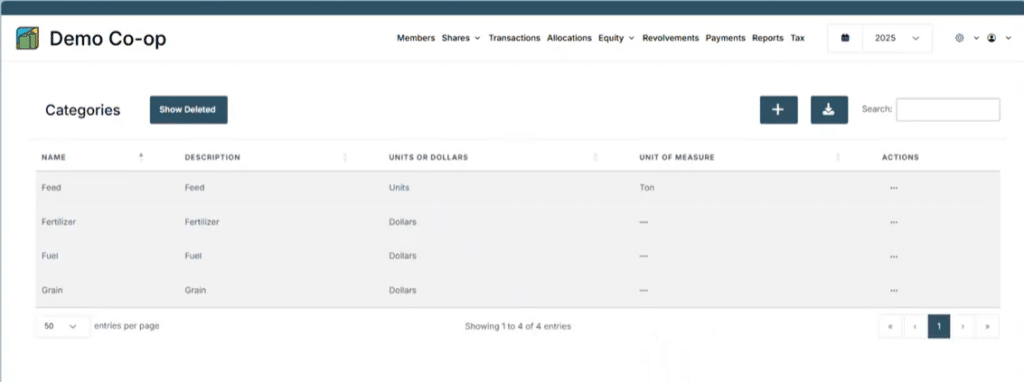
Upload transaction data through a simple CSV process and seamlessly incorporate information from existing ERP and accounting systems. Cooperatives can also include user-defined fields such as:
- Branch numbers
- Notes
- Custom reporting fields or other organization-specific information
This flexibility helps cooperatives capture and maintain the data they need for future allocations and reporting.
Creating Patronage Allocations
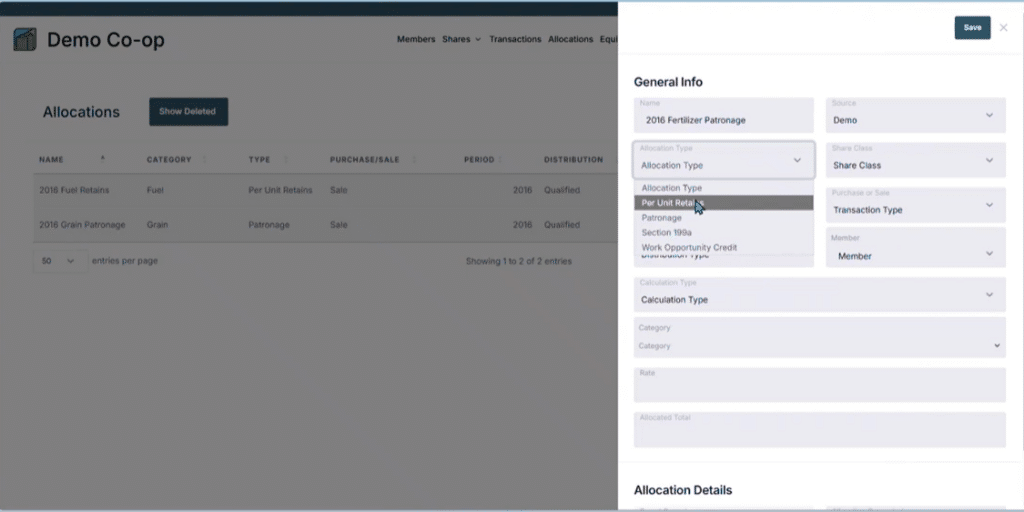
Once transaction data is loaded, cooperatives can create allocations. This is where the system begins calculating ownership credits based on member business activity. Because every cooperative has its own patronage program, Equity & Patronage provides a highly configurable allocation process. Organizations can define:
- Allocation names and periods
- Allocation categories
- Tax treatment
- Member-specific allocations
- Calculation methods
Common allocation types include:
- Patronage
- Per-unit retains
- Section 199A allocations
- Work Opportunity Tax Credits
The selected allocation type drives future tax reporting and determines how credits are categorized within the system.
Flexible Calculation Methods
The system allows cooperatives to determine exactly how credits should be calculated based on transaction activity. Two primary calculation options are available:
Rate-Based Allocations: The most common method. Examples include:
- $0.01 per dollar spent
- $0.02 per bushel delivered
- Any custom rate defined by the cooperative
The system reviews qualifying transactions and automatically calculates the resulting member credit.
Weighted Average Allocations: For cooperatives with more complex allocation requirements, weighted average calculations provide additional flexibility.
Regardless of the method selected, the goal remains the same: convert member business activity into equity credits accurately and consistently.
Test Before You Finalize – Run a Model Allocation
Before creating actual member credits, cooperatives can run a Model Allocation to preview results without creating official equity records.
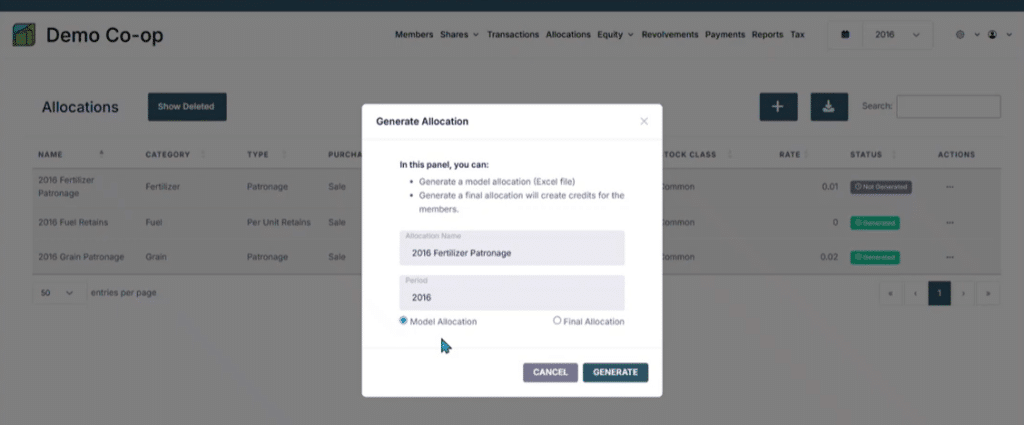
This allows teams to:
- Review projected payouts
- Validate transaction data
- Compare results against budgets
- Adjust allocation rates before finalizing
Once everything looks correct, the final allocation is generated:
- Member credits are created
- Source transactions become locked
- An audit trail is established
- Transactions cannot be allocated again
The system protects data integrity and preserves a complete audit trail of every credit calculation.
Maintain Complete Equity Visibility
As allocations accumulate over time, cooperative staff need a comprehensive view of member equity:
- Equity balances across all years
- Patronage allocations
- Retains
- Outstanding balances
- Allocation history
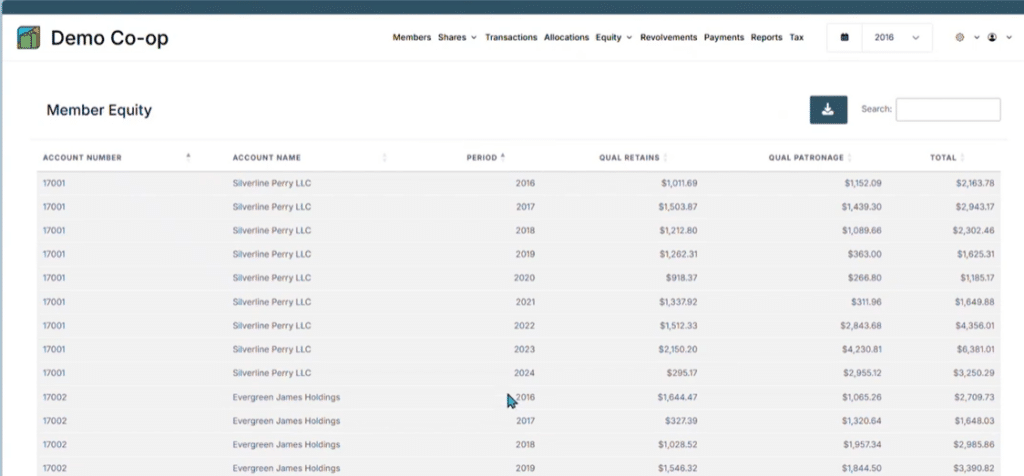
This simplifies member service activities and allows teams to quickly answer ownership-related questions.
Managing Equity Transfers
Member ownership can change over time. To support these situations, the system includes equity transfer functionality. Cooperatives can transfer:
- Entire equity balances
- Specific allocations
- Percentages of allocations
- Fixed dollar amounts
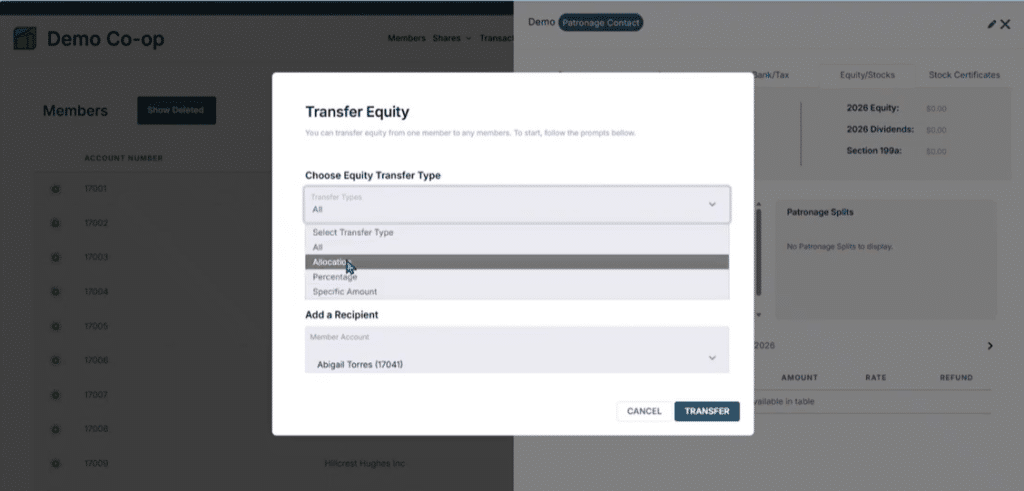
This makes it easy to handle member ownership changes while maintaining a complete transaction history and audit trail.
Revolvements: Turning Equity into Payments
After credits have been allocated, the next step is revolvement. A revolvement determines how equity credits are paid back to members. Like allocations, revolvements are highly flexible because every cooperative follows different payout practices.
Equity & Patronage supports two primary revolvement methods.
Standard Revolvement: With a standard revolvement, the cooperative selects:
- Specific allocation periods
- Equity categories
- Credit types
- A percentage to pay out
For example:
- Pay 50% of all 2016 patronage allocations
- Pay only a selected category
- Pay across multiple categories
The system automatically creates payment records and updates related equity balances.
Dollar Amount Revolvement: Sometimes a cooperative knows its total payout budget rather than a percentage.In these cases, administrators can define:
- Total dollar amount available for payout
- Starting allocation period
- Credit types to include
For example:
- Pay out $300,000 beginning with 2016 allocations
The system automatically calculates how much equity it can revolve based on the cooperative’s available budget.
Built-In Auditability
Every payment generated through a revolvement creates a clear audit trail. Cooperative staff can see:
- Original credits
- Amount paid
- Remaining balance
- Revolvement history
- Related payment records

This transparency helps maintain confidence in the process while simplifying future audits and member inquiries.
Finalizing Payments
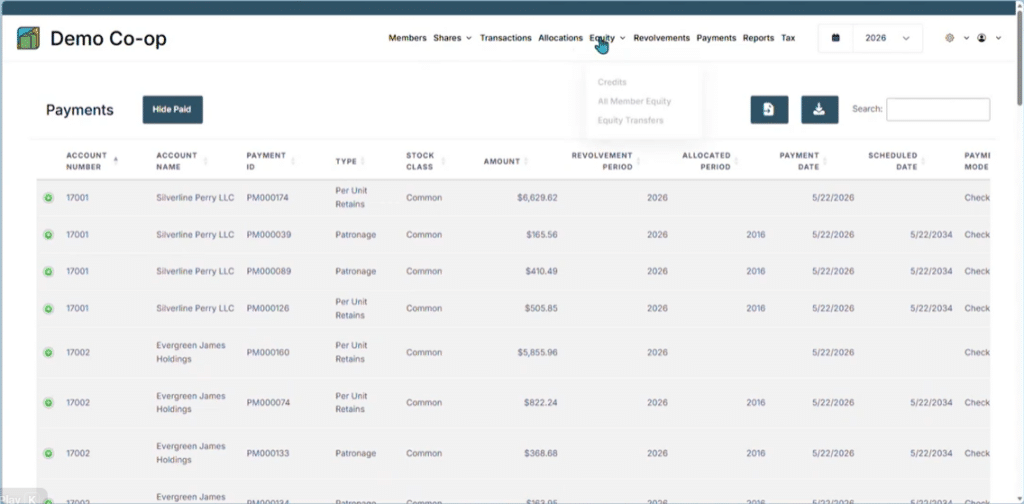
The final step is marking payments as complete. Export payment information and share it with your cooperative’s ERP or accounting system for processing.
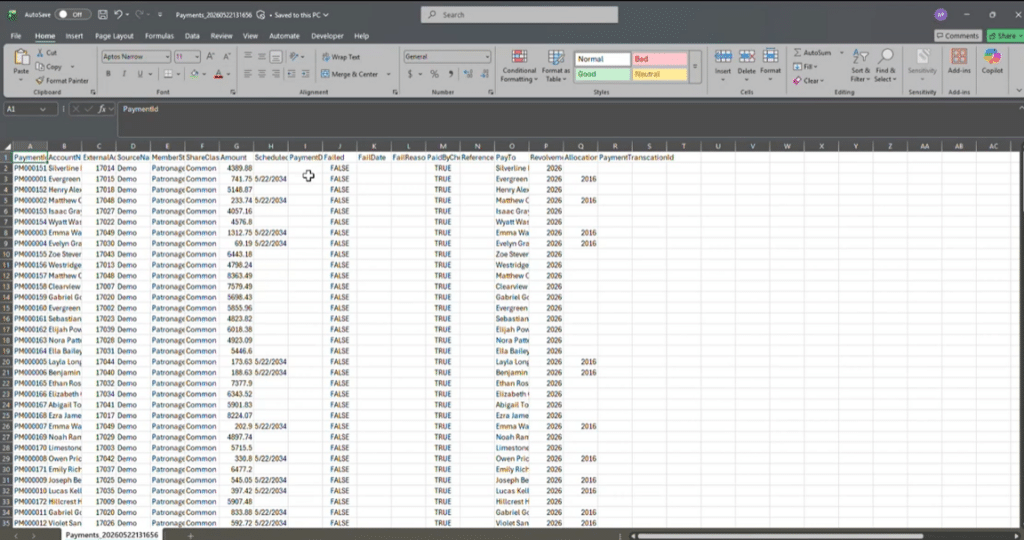
Payment details such as payment dates, check numbers, and reference numbers are imported back into Equity & Patronage solution. This updates the payment records and marks credits as paid, locks completed transactions, and updates reporting balances. At that point, the patronage lifecycle is complete.
A Flexible Solution for Every Cooperative
No two cooperatives calculate patronage or manage equity exactly the same way. Levridge Equity & Patronage provides the calculators, configuration options, and audit controls needed to support each cooperative’s unique approach.
From importing transactions and calculating allocations to managing transfers, revolvements, and final payouts, the solution gives cooperatives a modern, cloud-based way to simplify one of their most critical member management processes.